File API pricing: tiers, credit and the no-charge rules
How JustAPI prices PDF, image and spreadsheet calls: three volume tiers, 1 USD of sign-up credit, and the cases where a call costs nothing.
A file API is easy to budget when the price is clear. The question is not only what one call costs. It is how the price changes with volume, what you pay for a failed call, and what happens when a file cannot be made smaller.
This article sets out the JustAPI price rules for the three families of calls: PDF, image and spreadsheet. The numbers come from the price table in the service, and each one is shown at the first volume tier, the price for a new account.
Pay per call, from prepaid credit
There is no monthly fee and no minimum. You add credit and each call draws from it. Every new account gets 1 USD of credit with no card. Deposits start at 5 USD. An account funded in the last 90 days also gets 1 USD on day 30 and on day 60 after the deposit.
Credit is counted in millionths of a dollar. Only the credit you paid for can be refunded.
Three tiers for each operation
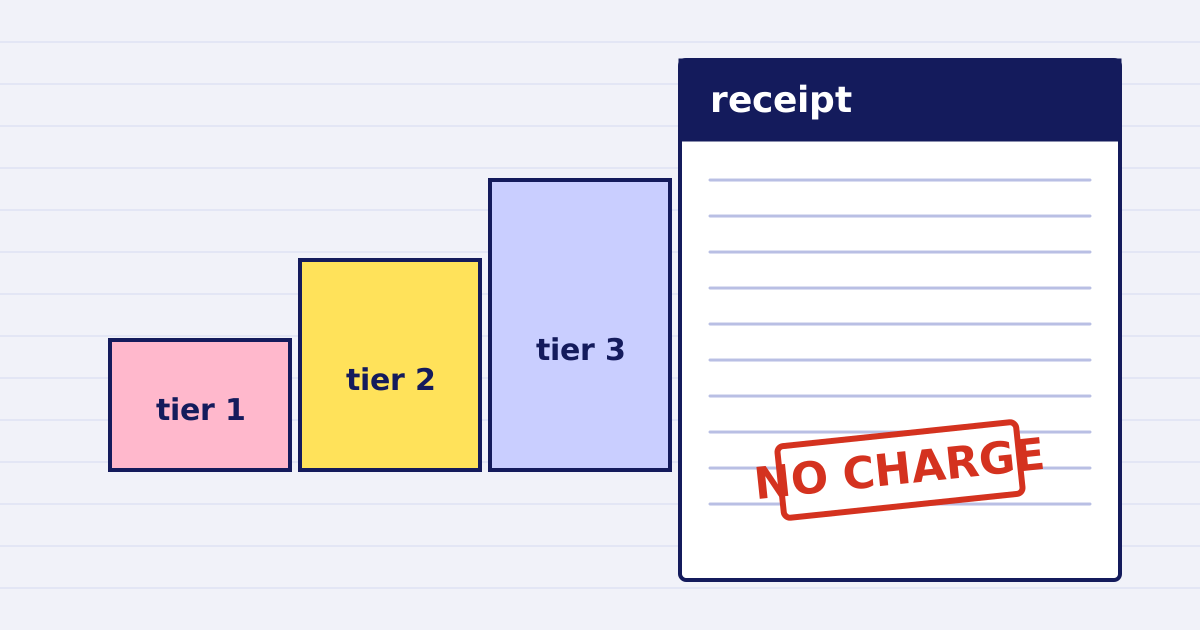
Each operation has three volume tiers. Units are counted per account and per calendar month in UTC. The first 1,000 units in a month are charged at tier 1, the next at tier 2, and the rest at tier 3. The price falls as your volume rises.
| Operation | Tier 1 | Tier 2 | Tier 3 |
|---|---|---|---|
| PDF compression, input up to 25 MB | $0.030 | $0.025 | $0.020 |
| PDF compression, input 25 to 200 MB | $0.060 | $0.050 | $0.040 |
| PDF merge, result up to 25 MB | $0.015 | $0.012 | $0.010 |
| PDF merge, result 25 to 200 MB | $0.040 | $0.035 | $0.030 |
| Image optimization, per image | $0.0012 | $0.0010 | $0.0008 |
| Image batch, per image that succeeded | $0.0012 | $0.0010 | $0.0008 |
| JSON to Excel, per file | $0.008 | $0.006 | $0.005 |
| JSON to Excel, per 1,000 cells | $0.00003 | $0.000025 | $0.00002 |
The quality verification add-on for PDF compression costs $0.008 at tier 1. The batch has no surcharge. The per-file and per-cell charges for spreadsheets add together.
The PDF merge price depends on the size of the result, not on the size of the inputs. The compression price depends on the size of the input file.
A worked example
Suppose a month has 1,200 successful image optimizations. The first 1,000 are charged at tier 1, and the next 200 at tier 2.
- 1,000 at $0.0012 is $1.20.
- 200 at $0.0010 is $0.20.
- Total: $1.40.
The tiers are graduated. Only the units above each break are charged at the lower price, so a 1,200th image does not reprice the first thousand.
When a call costs nothing
Your charge should match work that helped you. These are the cases where the bill is $0.00:
- The PDF could not be made smaller. You get your original file back.
- The optimized image is no smaller than the source. It is still returned, and nothing is charged.
- An image in a batch failed. You pay for the images that succeeded, and one bad image never fails the others.
- A merge failed. The merge is all or nothing. If any source is unreadable, no file is returned and nothing is charged.
- Your request was invalid. Any 4xx response costs nothing.
- Something broke on the service's side. Any 5xx response costs nothing.
Spreadsheet calls are charged only once the file is generated and uploaded. A 4xx or 5xx on a spreadsheet call costs nothing.
Budget before you scale
Multiply your expected monthly units by the tier-1 price for each operation, then subtract the tier discounts you will reach. A workflow that compresses 1,500 PDFs of up to 25 MB in a month pays the tier-1 price for the first 1,000 and the tier-2 price for the next 500. Run the numbers for each operation separately, because a single workflow often calls more than one of them.
Add a margin for retries and for test calls. Retries that reuse an idempotency key are not charged twice, but a test that creates new jobs is. Keep a separate test key for experiments, and watch its spend.
Check the ledger
Responses include a billing object with charged_micros and balance_micros. Store those values with your job. When you need the balance right after a charge, read the ledger rather than the account, because the account view can lag by up to a minute.
The GET /v1/ledger endpoint lists each movement. A reconciliation against your own job records is the simplest way to find a difference.
Results are short-lived
Results from the API are deleted automatically after 24 hours, or at once when you acknowledge the download. Free tool results are deleted within the hour. Store the file in your own system if you need to keep it. The service is not an archive.
What the numbers came from
Two measured runs show the cost in practice. A 59-page photo report went from 27.2 MB to 5.1 MB, which is 81% smaller, and it cost $0.04 at the time of the run. A batch of 250 images finished in 23 seconds and cost $0.20 at the time. Prices change as the price table changes, so calculate your own volume with the pricing page before you set a budget.
Start with a test budget
Start free at app.justapi.tech. New accounts get 1 USD of credit with no card. Run a small set of your own files, check the billing object for each call, and confirm that the rules above match what you see. Then add a deposit when you are ready to run the real volume.
Keep reading
-
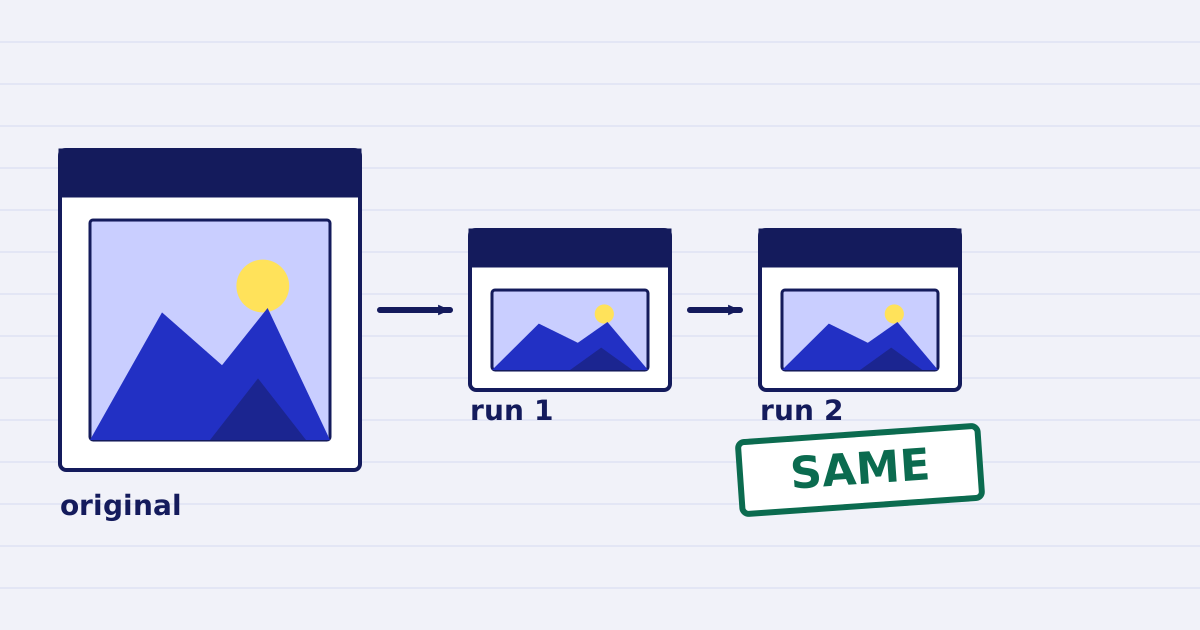
Compress a PDF twice: the second run returns the same bytes
A second compression run skips images that are already at target, so the file comes back unchanged. We measured it, and the case where it does more work. -
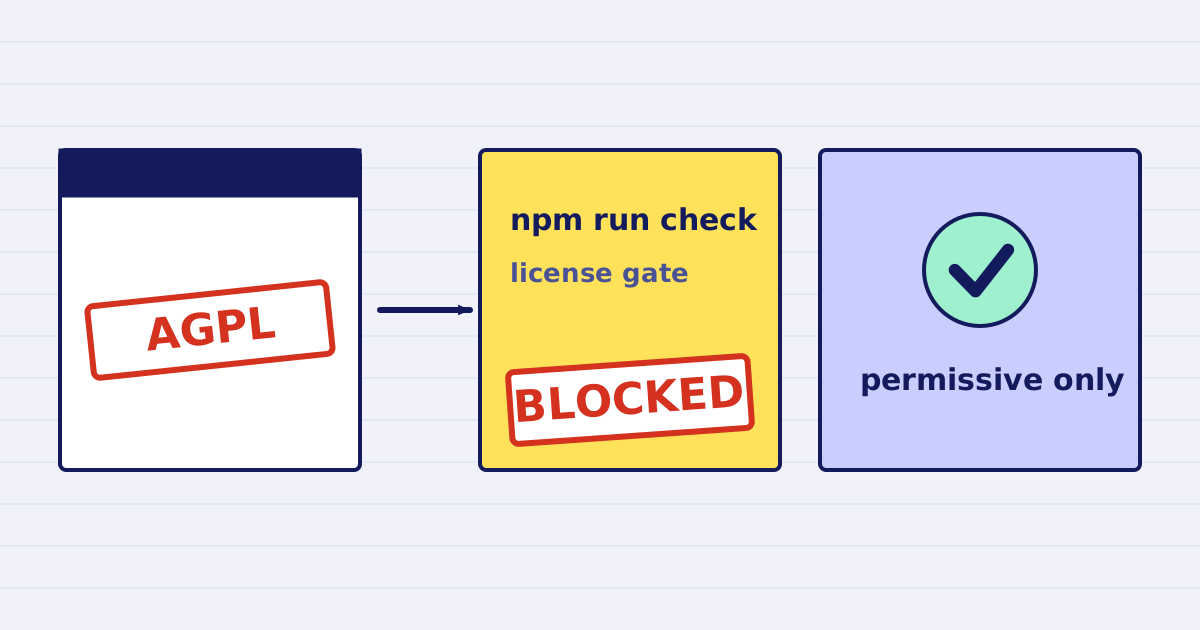
Why our PDF pipeline avoids Ghostscript and MuPDF
Ghostscript and MuPDF are AGPL-licensed. Here is what that license asks of a hosted API, and how our build blocks AGPL and GPL dependencies.